
Texas Replaced County VINE
The central current fact is a service transition. Texas county victim notification moved from VINE to IVSS-Counties on September 1, 2025. The Texas Attorney General said existing county registrations would carry forward. TDCJ IVSS remains a separate system for people in TDCJ custody or on state parole or mandatory supervision.
The Attorney General transition page is the official starting point for county notification.
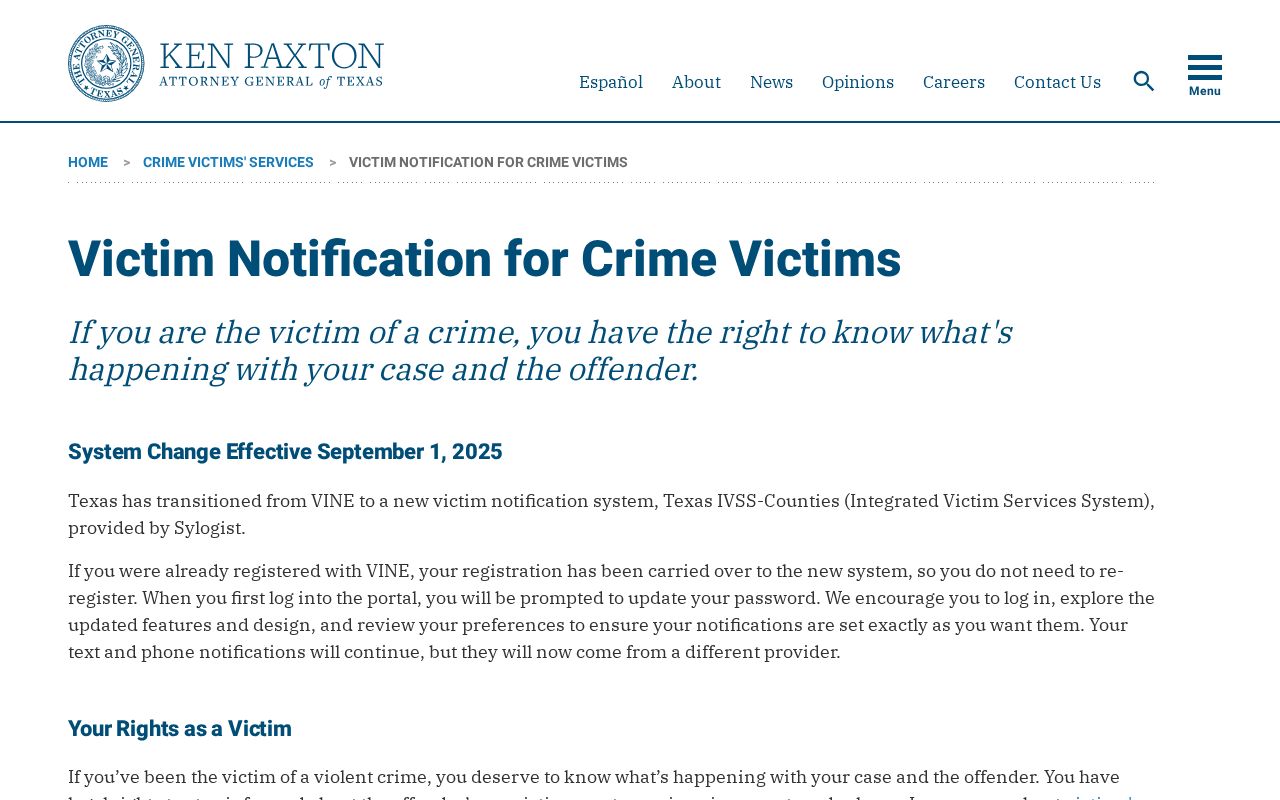
The image documents the transition, not a public Hidalgo recent-release list. Current county searching and registration depend on the successor interface and its available tenant workflow.
Choose Hidalgo or TDCJ
Start with the custodian. A person booked in the Hidalgo County Adult Detention Center belongs in the county/current-custody tenant. Someone held at the Reynaldo V. Lopez Unit or Manuel A. Segovia Unit belongs in TDCJ systems, even though those facilities are in Hidalgo County. If the county released a person to TDCJ, verify or create the TDCJ registration. Do not assume an alert follows the person across systems.
County IVSS and TDCJ IVSS serve related but distinct records. TDCJ covers state custody plus parole and mandatory supervision events. County notification concerns the county custody episode. A municipal arrest may first require checking whether the arresting agency transferred the person to Hidalgo County.
Federal BOP, USMS, and ICE custody are outside these two state notification paths. Use the BOP locator for sentenced federal custody, the federal docket or USMS record route for many pretrial cases, and ICE ODLS for eligible immigration custody searches.
The prior custody record often names the next system. A Hidalgo movement entry that names TDCJ should lead to a state search by TDCJ or SID number. A federal writ calls for the federal docket and USMS route. An ICE destination calls for ODLS with the identity fields it requires. Texas alerts cannot confirm those outside events.
Municipal custody adds one more handoff. A city arrestee may be cited, released by a magistrate, or moved to Hidalgo County. Contact the arresting agency for its custody log, then register after locating the downstream record. Choosing the wrong tenant can yield a blank result that says nothing about release.
Search One Hidalgo Inmate
A notification search should be person-specific. Broad browsing can confuse people with similar names and does not prove that a result belongs to the custody episode at issue.
- Decide whether the person is in Hidalgo county custody or TDCJ custody. Use the service tied to that custodian.
- Enter the exact first and last name or the identifier offered by the interface. For TDCJ, use the TDCJ number or SID when known.
- Compare the match with birth data, identifier, facility, case, or other displayed facts. Do not register on a name alone when multiple matches appear.
- Open the matched record and read its exact custody status. Save the service name and date checked.
- If the person is shown as released, moved, or discharged, confirm the event with the Hidalgo Sheriff or TDCJ record that produced it.
If no match appears, recheck spelling, aliases, identifiers, and custodian. A transfer, aging record, transition issue, or input mismatch may explain a blank. For a wider custody search, use Home.
Hidalgo Notification Record Fields
The successor interface may differ from legacy VINELink screens. Read only the fields actually displayed and preserve their labels.
| Field | How to use it |
|---|---|
| Name and identifier | Confirms that the subscription is tied to the intended person. |
| Custody status | Reports the service’s current event label, subject to update lag. |
| Facility or custodian | Shows which office should confirm the event. |
| Release, transfer, or discharge | Describes a specific custody change; the terms are not interchangeable. |
| Notification choices | May offer text, call, or email and current preference settings. |
| TDCJ status event | May concern release to supervision, discharge, or a parole-related event. |
A projected date is not an actual release. A county departure may be a transfer. A TDCJ discharge means the sentence and supervision obligation ended, while release to parole or mandatory supervision continues state oversight in the community.
Register for Hidalgo Alerts
Use the current interface displayed by the applicable system. Current Attorney General material says users may choose text, call, or email and can set preferred hours or blackout dates. Exact options can change.
- Open the matched individual record, not a general search page.
- Select registration or notification and choose the event types offered.
- Provide the phone number, email address, or text destination requested.
- Complete any confirmation or PIN step shown by the current service.
- Keep the registration details secure and update them when contact information changes.
- If custody moves from Hidalgo County to TDCJ, check registration in TDCJ IVSS separately.
Notifications are informational. They may arrive after the event or fail because contact settings changed. For safety planning, follow the official service directions and maintain direct contact with the appropriate victim-services office where applicable.
Legacy Texas VINE Steps
Older Texas material used the VINE and VINELink names. Its workflow allowed a caller to use 877-894-8463 or the web service, enter a first and last name or offender number, choose the matched in-custody or pending case, register phone numbers or email, and create a four-digit phone PIN. The recipient entered that PIN when called to confirm receipt. Unconfirmed automated calls could retry for up to 48 hours.
Those directions must be labeled legacy. They do not prove that IVSS-Counties uses the same screens or PIN behavior after September 1, 2025. The current TDCJ portal guide separately documents state-system confirmation and PIN behavior. Follow the interface now shown for the relevant record, and do not mix county credentials with a TDCJ registration.
Confirm Hidalgo Release Alerts
An alert is corroboration, not the final custody record. For a county event, ask the Hidalgo Sheriff for the release or movement date, time, disposition, authority, destination, and holds. For a TDCJ event, compare the TDCJ status and request the actual release or discharge record when needed.
The TDCJ IVSS landing page shows the distinct state-custody system.
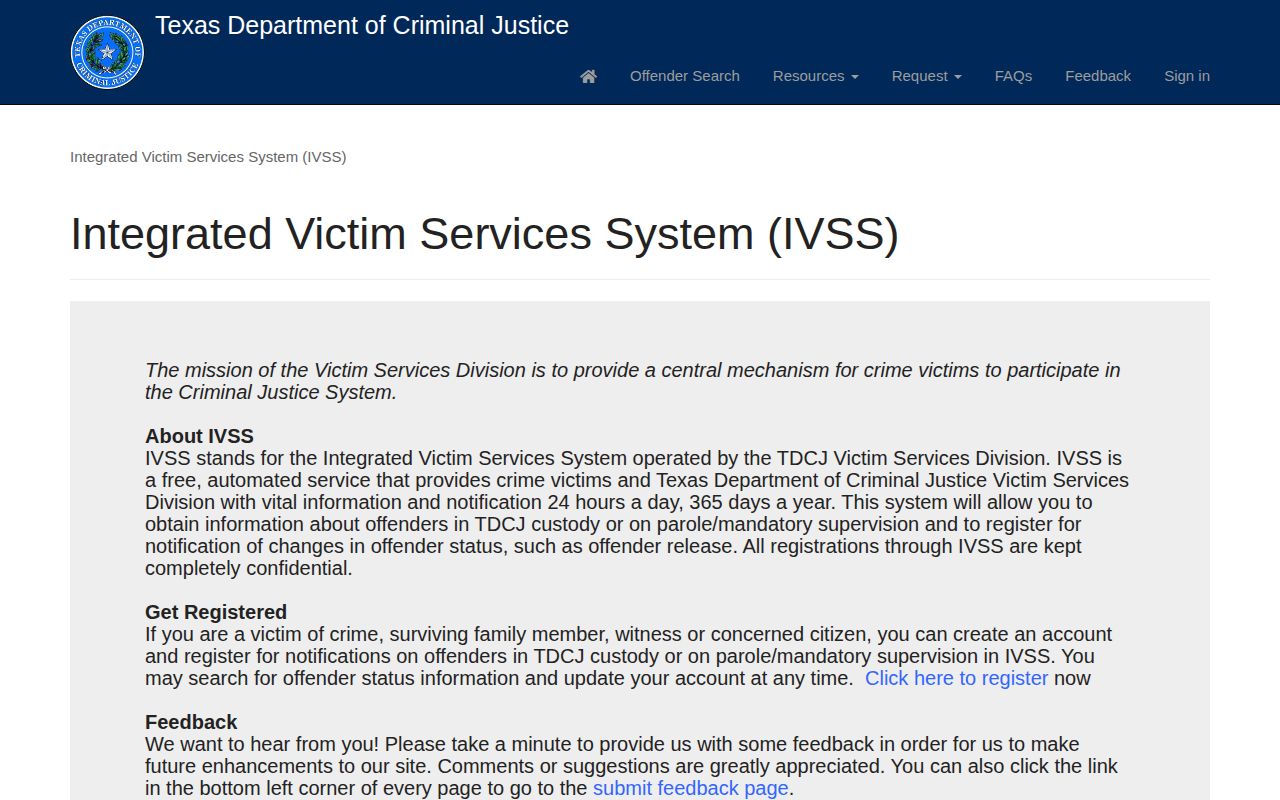
The state screenshot should not be used as evidence that a county detainee is registered. It identifies the separate route for a TDCJ offender.
When an alert and roster disagree, compare timestamps. The jail may have completed local release before a transfer intake appeared. A notification may post after the agency record. Name the limited fact each source proves.
Hidalgo VINELink Search Limits
Neither notification system is a universal people locator. A no-result does not prove release. It may reflect spelling, identity mismatch, transfer, coverage, record aging, or the county-system transition. Likewise, a “released” label does not explain whether the destination was the community, another jail, TDCJ, USMS, or ICE.
TDCJ’s standard public inmate search is limited to people currently incarcerated in TDCJ. Its disappearance is not discharge proof. Use the inmate-information email or a precise public-information request for basic or historical release facts. County alerts should be checked against the Sheriff record.
VINELink does not cover the federal BOP locator. ICE has its own locator inputs and recent-release window. The Texas DPS sex-offender registry is also separate and applies only to public reportable registrations; it is not a general release directory. For current county activity without a labeled feed, see Jail Releases: 24 Hours.
Keep the matched identifier, system name, registration date, and confirmation receipt together. Protect the subscriber’s phone number, email, PIN, and safety preferences. Test that the device accepts the selected delivery type. Spam filters, blocked calls, blackout hours, or an incomplete confirmation can interrupt delivery.
Review registration after a transfer. A county record and later TDCJ record are separate. Federal and immigration moves require their own agency tools. If an alert conflicts with a live status, compare event times with the Sheriff or TDCJ entry. A written release record is stronger evidence of an old event than a notification screenshot.