
Hidalgo Projected Versus Actual Release
A projected release date is an estimate produced from the sentence, offense date, offense category, custody credit, and release laws that apply. TDCJ's definition treats older mandatory-supervision-eligible cases differently from later cases. For an eligible offense before September 1, 1996, TDCJ says release occurs on the projected date if the person is not paroled. In a later case eligible for discretionary mandatory supervision, BPP action can affect release. For someone not approved or not eligible, the projected date may be the discharge date.
Parole eligibility is only the point when a case may be considered. A favorable parole vote is a decision. Discharge is the completion of the sentence. Actual release is physical departure or transfer shown by an agency record. These dates may be different.
A pretrial detainee has no sentence-based projected release date. Bond, dismissal, plea, or another court order supplies legal authority, but a warrant or detainer may still prevent community departure.
Search Hidalgo Projected Release Dates
Use the system that holds the sentence. The TDCJ Inmate Search covers people currently incarcerated in a TDCJ facility. It is not a permanent public archive of discharged prisoners. The Hidalgo County portal covers county jail and case records, while the court judgment and Sheriff calculation control a county sentence.
- Identify county jail or TDCJ custody. Lopez and Segovia are state facilities despite their Edinburg addresses.
- For TDCJ, search by TDCJ number or SID number when possible. Name searches require careful identity comparison.
- Record the unit, offense, county of conviction, projected date, and parole-review fields while the person remains listed.
- After the person disappears, use the TDCJ email or public-information route to request incarceration and release history.
- For a county sentence, obtain the judgment, jail-credit entries, Sheriff calculation, and actual release or transfer timestamp.
| Field | Use | Limit |
|---|---|---|
| TDCJ number | Strong state identifier | Does not cover county-only custody |
| SID number | Alternate state identifier | Must match the correct person |
| Name | Broad search route | Needs age and case comparison |
| Projected release | Current calculation | Not actual departure |
| Parole review | Case consideration status | Not approval or release |
TDCJ Search Covers Current Custody
The state form expressly limits online information to people currently incarcerated in a TDCJ facility. That boundary matters when looking for a former prisoner. A blank result after release does not prove discharge, the release type, or the date. Request the actual history instead.
The official search interface below shows the state fields and current-custody limitation. It applies to Lopez, Segovia, and other TDCJ units, not to a person whose only custody was the Hidalgo County Adult Detention Center.
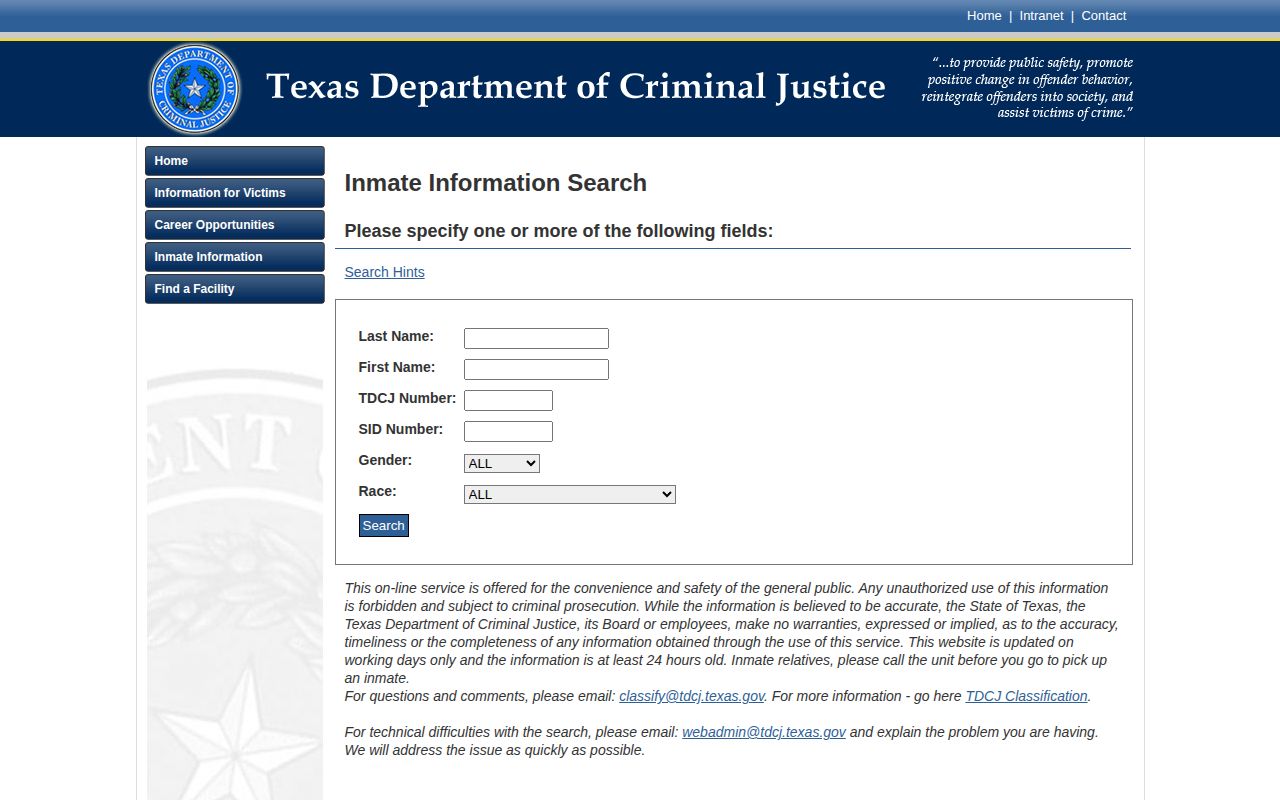
Capture useful fields before departure, then move to TDCJ records and supervision channels afterward.
Texas Good Time Is Limited
Texas Government Code Chapter 498 governs TDCJ good-conduct time. Section 498.003 describes classifications rather than one universal sentence reduction. At its baseline, trusty and Class I classifications may earn specified days per time served, while Class II has a lower rate and Class III earns none. Some eligible program participation can add credit. The current statute must control because classification, conduct, and amendments matter.
Good-conduct time is a privilege, not a vested right. It can be forfeited, suspended, or restored under the chapter. It affects parole or mandatory-supervision eligibility only as the law allows and does not erase the underlying sentence. A discipline or classification change can therefore move a displayed date.
Texas does not apply a blanket 85-percent rule to every TDCJ prisoner. Federal shorthand should not be imported. Texas uses offense-specific calendar-time formulas, good-time classifications, exclusions, and mandatory-supervision rules.
Hidalgo Parole Eligibility Formulas
Government Code section 508.145 supplies different formulas based on the offense, sentence, and governing date. The ordinary formula generally reaches eligibility when calendar time plus allowed good time equals one-fourth of the sentence or fifteen years, whichever is less, subject to the statute's categories. That is eligibility for review, not a release date.
For aggravated categories described in section 508.145(d), the central calculation uses actual calendar time and excludes good-conduct time: one-half of the sentence or thirty calendar years, whichever is less, with minimum and special rules where applicable. Life sentences and other listed classes receive separate treatment. Section 508.149 also excludes listed cases from mandatory supervision. An eligible post-1996 case can face a discretionary BPP denial under its statutory standard.
Only the controlling subsection should be applied to a real case. The conviction judgment, offense date, sentence, consecutive terms, and amendments all matter.
Hidalgo County Jail Good Conduct
A county jail sentence follows a different law. Code of Criminal Procedure Article 42.032 permits a sheriff to grant commutation for good conduct, industry, and obedience. The deduction cannot exceed one day for each day of the original sentence actually served. Defined misconduct can cause forfeiture, and the Sheriff must keep conduct and calendar records.
Do not apply a TDCJ projected date or classification rate to the Hidalgo county jail. The local calculation can depend on the judgment, jail credit, consecutive terms, other holds, and the Sheriff's lawful application. Request the calculation and release timestamp rather than doing arithmetic from an arrest date. A county booking may also end through transfer to TDCJ, which starts a separate state-custody record.
Why Hidalgo Release Dates Change
One change can alter the estimate or prevent departure. The record should identify which event occurred rather than treating each mismatch as an error.
| Factor | Effect | Record to check |
|---|---|---|
| Disciplinary forfeiture | Changes allowed credit | TDCJ classification or conduct record |
| Corrected jail credit | Moves the sentence calculation | Judgment and time-credit record |
| Amended judgment | Changes legal sentence terms | Controlling court docket |
| Consecutive sentence | Links service of more than one term | Judgments and TDCJ calculation |
| BPP decision | May grant, condition, delay, or deny release | Live BPP voting result |
| Program requirement | Requires completion before processing | BPP code and TDCJ program record |
| Warrant or detainer | May cause continued custody or transfer | Sending and receiving agency records |
An FI-1 or similar favorable code still does not prove the person crossed the gate. Review and Release Processing can clarify remaining conditions, and the actual history records the departure.
TDCJ Email Release Date Records
The TDCJ inmate-information email page describes fields available without a fee, including number, location, conviction information, incarceration history, and projected date. Send a full name and seven-digit TDCJ number to pia@tdcj.texas.gov. Without the number, provide an exact birth date or approximate age and county of conviction. Ask for release or discharge history and supervision status when the online search no longer returns the person.
The official page's projected-date definition and field list are captured below. It does not provide photographs through this service.
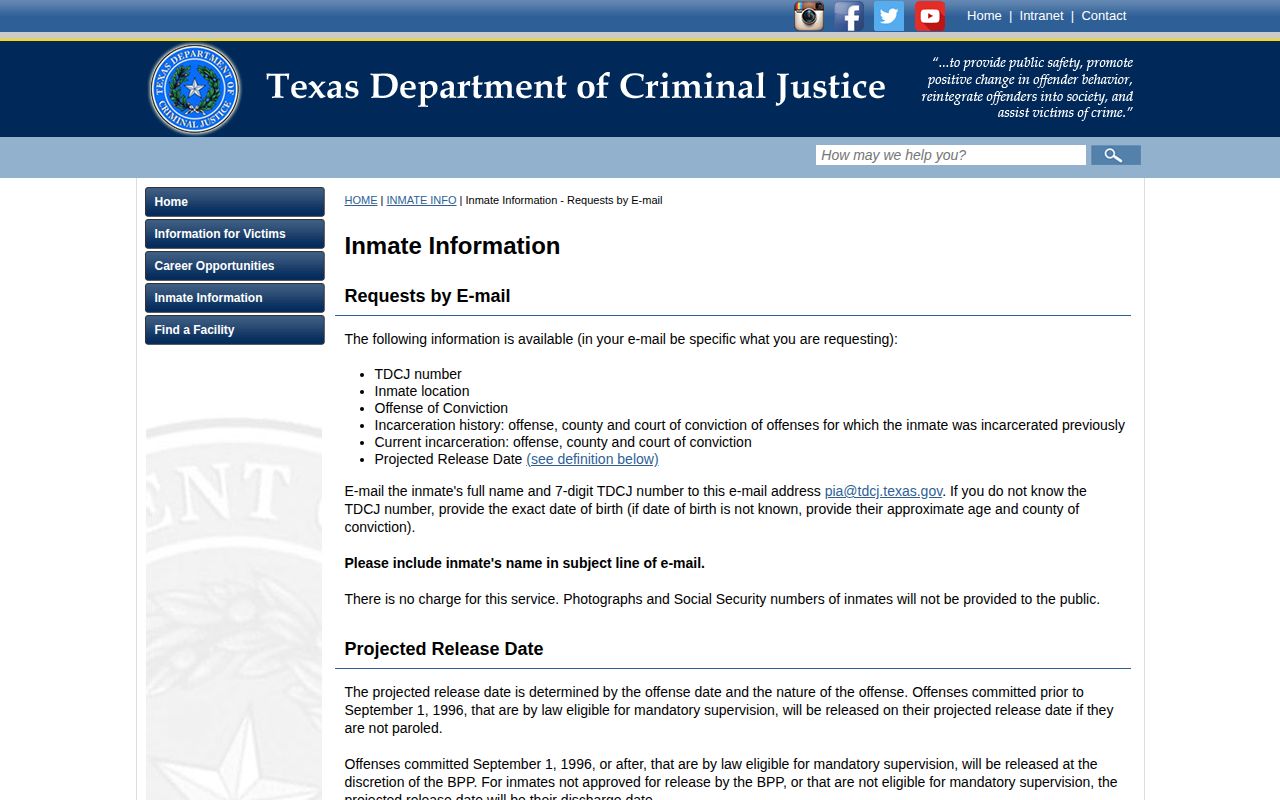
The response should be matched to the court case and actual custody episode.
Confirm Hidalgo Actual Release
For state custody, request TDCJ incarceration and release history, then check Hidalgo probation and parole routes if supervision may follow. For county custody, use the Sheriff release or transfer timestamp and the durable court disposition. Texas notification tools can supply alerts, but a notice may arrive after the event and is not a substitute for the originating record.
If a county record says released to TDCJ, the person did not return to the community. Likewise, a TDCJ departure may be a transfer under a warrant or detainer. Compare the sending record with intake by the next custodian. That paired evidence is stronger than roster absence or a projected date. Keep the dated agency response with the matching judgment.
Hidalgo Date Conflicts by Custodian
The same person can have several correct dates. A Hidalgo booking may end when the Sheriff transfers the person to TDCJ. TDCJ can then calculate a projected release, record a board review, and later post an actual discharge or movement. A court docket may show an order before either agency finishes physical processing. Each timestamp answers a different question.
When sources conflict, identify the custody episode and event label before choosing a date. A certified agency movement record with identity and time is stronger than a current roster absence. A receiving-custodian intake can prove a handoff. A court order proves legal authority, while the jail or prison record proves when departure occurred. Avoid combining those events into one universal release date.