
Segovia Pre-Release Does Not Guarantee Release
TDCJ expressly classifies Manuel A. Segovia Unit as a male pre-release facility. Its official directory also lists reentry-oriented programs. That designation describes the unit and its work. It does not establish that every person there will depart on a displayed projected date or enter the community directly.
A Segovia prisoner can leave on parole, mandatory supervision, discharge, or another lawful movement. Board action may apply. Program terms, sentence calculations, release-plan review, warrants, and detainers can delay departure or change the destination. The record sequence matters:
BPP decision, if required → TDCJ release processing → actual departure or transfer → Parole Division or discharge status.
Confirm Segovia Release Status
Start with the TDCJ current-inmate search. A TDCJ number or SID number is safer than a name alone. Compare the unit, age information, offense, and county of conviction. The public form covers current TDCJ incarceration, so a former prisoner may no longer return.
- Match the identity and confirm that the location is Segovia.
- Save the projected date and parole review fields as estimates or case milestones.
- Check the BPP status route if parole or mandatory supervision may apply.
- Read the live voting-code legend instead of guessing what an FI, RMS, NR, SA, or DMS code means.
- Request TDCJ incarceration and release history after departure, then confirm the assigned supervision office.
At pia@tdcj.texas.gov, give the full name and seven-digit TDCJ number. If that number is unknown, provide exact birth date or approximate age and county of conviction. Ask for release date, release type, incarceration history, and supervision status.
Segovia Unit Contact and Capacity
The official Segovia directory supplies the facility address, phone, classification, and listed population capacity. Use it for current facility contact, not as proof of a particular prisoner's custody or release.
1201 E. El Cibolo Road
Edinburg, TX 78542
Phone: 956-316-2400
The matched official image below documents Segovia's pre-release identity and contact information.
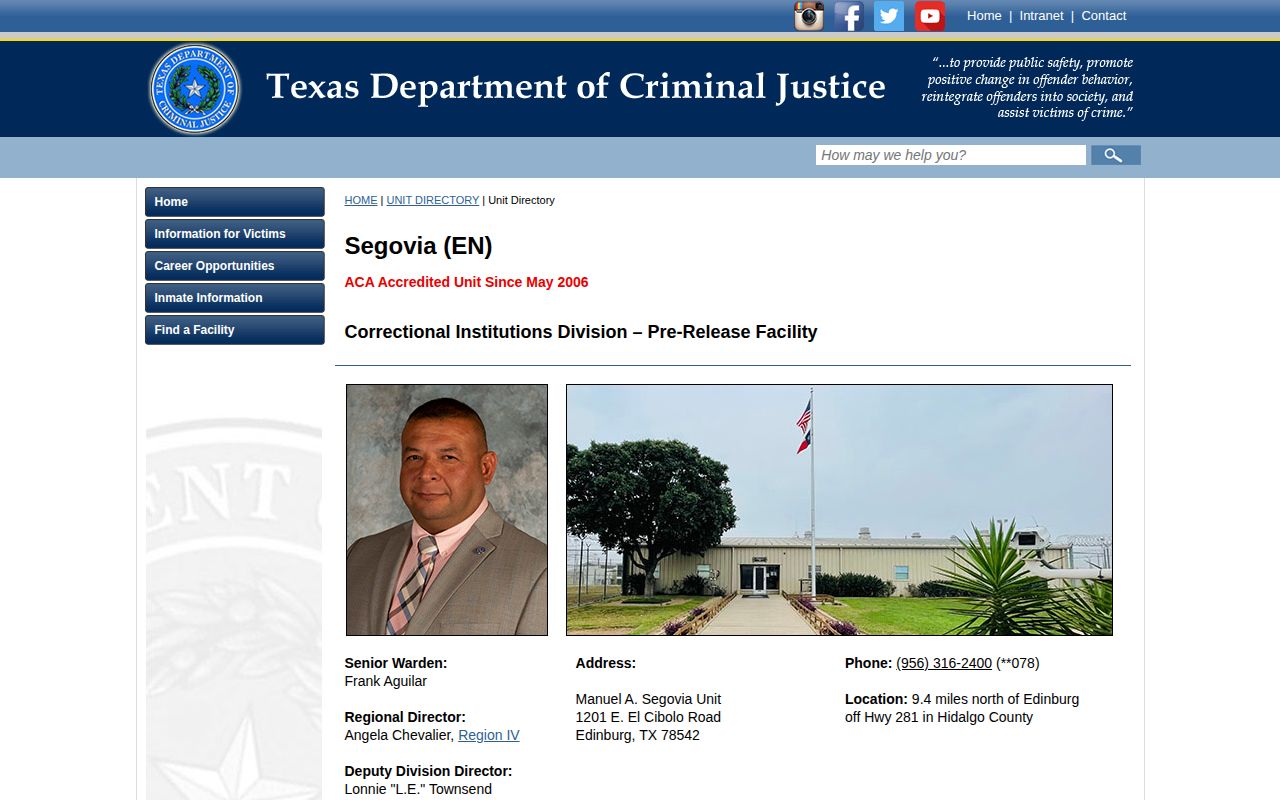
The directory should be reopened for time-sensitive details because unit information can change.
Segovia and the El Cibolo Cluster
Segovia sits near the Hidalgo County Adult Detention Center and Reynaldo V. Lopez Unit along the El Cibolo Road area. The shared geography can hide an important records boundary. Segovia and Lopez are TDCJ facilities. The adult detention center is the county jail. One is not a wing of another, and they do not share a public release roster.
| Facility | Custodian | Release source |
|---|---|---|
| Segovia Unit | TDCJ | TDCJ history, BPP/Parole Division when applicable |
| Lopez Unit | TDCJ | TDCJ release or discharge record |
| Hidalgo adult jail | Hidalgo Sheriff | Sheriff release or transfer record |
A county record may show an earlier transfer to TDCJ. That handoff is not the later Segovia release. The Hidalgo County released inmate routes keep the events separate.
Segovia Parole Decision Records
The BPP San Antonio office's unit-assignment list includes Segovia. That assignment concerns parole review. It does not mean a released person reports to San Antonio. Field supervision follows the approved residence and case assignment, and it may be outside Hidalgo County.
Texas ordinary parole consideration uses file voting rather than a formal individual public hearing. Parole Division identifies initial-review files in advance, an institutional parole officer develops the case summary, and a three-member panel votes. Two matching votes decide the result. There is no Segovia hearing calendar to use as a release schedule.
FI-1 directs release when eligible. FI-2 points to a future month and year. Other FI codes can require a TDCJ program. RMS concerns mandatory supervision. NR, SA, and DMS are denial results with distinct rules. Always use the current BPP legend. Even a favorable result must be paired with actual departure.
Segovia Projected Release Limits
A projected release date is a legal calculation, not a reservation. Government Code section 508.145 uses offense and sentence categories for parole eligibility. Chapter 498 governs good-conduct classifications. Credits may affect eligibility or calculations where allowed, but they do not reduce the underlying sentence and can be forfeited. Texas does not impose one blanket 85-percent rule on every state prisoner.
For eligible later mandatory-supervision cases, BPP can deny release based on the statutory findings in section 508.149. Corrected credit, discipline, an amended judgment, consecutive terms, a program condition, a new case, or release-plan review can also move the expected date. The Hidalgo projected release lookup explains which field answers each question.
Segovia Supervision Destination
After a parole or mandatory-supervision release, TDCJ Parole Division handles field supervision. The McAllen District Parole Office and DRC serve the Hidalgo area, but a Segovia departure does not prove assignment there. A person approved to live elsewhere may report to another district. Call the listed office before making a location claim.
Hidalgo County CSCD handles court-ordered probation and pretrial programming. It is not TDCJ parole. Use the judgment and release type to choose between them. The Hidalgo supervision comparison also explains why a board review date, release date, and supervision start date may differ.
Segovia Transfer or Community Release
A departure record may identify another custodian. If ICE is the destination, the event is a custodial handoff rather than immediate community release. ICE describes a detainer as a request for notice and up to forty-eight additional hours so DHS can assume custody. Use the ICE detainee locator for current detainees and recent ICE releases within its stated coverage.
A warrant from another jurisdiction can also cause transfer. Compare the TDCJ movement with intake by the receiving agency. If the record instead shows parole or mandatory supervision, confirm the TDCJ supervision status and assigned office. If it shows discharge, obtain the sentence-completion history. The label "released" must stay tied to the named custodian.
Segovia Release Record Proof
The strongest record is an agency-produced release, discharge, or movement history with the correct identity and timestamp. A receiving-custodian intake strengthens proof of transfer. A judgment establishes the sentence and legal authority, but not always the exact time processing finished. A notification can help, though it may arrive after the event.
Roster absence alone proves little. TDCJ's online search is current-custody focused. A missing result may reflect release, transfer, spelling, or another search problem. Preserve the TDCJ number, compare the same custody episode, and request the actual history before stating the outcome.
Segovia Records After Departure
Online removal is not the end of the official record. Request TDCJ incarceration history and the actual release or discharge event, then compare it with the court judgment and any supervision status. This record chain is more reliable than assuming a missing current-inmate result proves community release.