
Hidalgo Parole and Probation Types
Texas parole is a discretionary release from prison that permits part of a sentence to be served under supervision. Mandatory supervision is another state release mode governed by statute. The Texas Board of Pardons and Paroles, or BPP, makes release decisions, while the TDCJ Parole Division prepares cases, processes releases, and supervises people after release. Neither agency is Hidalgo County probation.
Probation, also called community supervision, is imposed by a court. Hidalgo County Community Supervision and Corrections Department, or CSCD, administers adult county supervision and a separate pretrial program. Pretrial supervision occurs before a final judgment and is not probation after conviction. The controlling court order and cause number show which program applies.
| Status | Authority | Best verification record |
|---|---|---|
| Parole | BPP and TDCJ Parole Division | TDCJ/BPP status and release record |
| Mandatory supervision | BPP and TDCJ | TDCJ status, decision, and release history |
| County probation | Sentencing court and Hidalgo CSCD | Judgment, probation order, and CSCD confirmation |
| Pretrial supervision | Court and local program | Bond/release order and case docket |
- Discharge
- The end of a sentence or supervision term, not merely departure from a facility.
- Absconder
- A supervised offender whose whereabouts are unknown after stopping required reporting.
- Detainer
- A request or notice from another authority that can lead to transfer instead of community release.
Verify Hidalgo Post-Release Supervision
Begin with identity. Similar names are common, so use the TDCJ number or SID number when available and compare date or age information. The official parole status route and BPP Parole Status Line at 844-512-0461 can address state review or supervision. A current TDCJ inmate result concerns prison custody, not proof of departure.
- Read the judgment, release record, or TDCJ result to identify the custody episode and release type.
- For parole or mandatory supervision, check TDCJ/BPP status with a firm identifier and ask whether release processing is complete.
- For probation, use the Hidalgo court docket and the probation order to identify the cause and supervising department.
- Confirm the assigned office. Field supervision follows the approved residence and case assignment, not merely the releasing unit.
- If facts conflict, compare the actual departure record, decision date, and supervision start date instead of merging them.
McAllen Parole Office Records
The official Region IV directory lists the McAllen District Parole Office and District Reentry Center. The DRC directory says the center covers Hidalgo and Starr Counties. That local presence does not prove a specific person reports there. An approved residence outside Hidalgo County can produce a different field-office assignment.
7601 South 10th Street
McAllen, TX 78503
Phone: 956-664-0250
Fax: 956-630-5214
Call before treating the office as the assigned reporting site. Staff may limit details, and a public status channel does not publish private reporting schedules or individual conditions. For general division routing, use the TDCJ Parole Division directory.
Hidalgo Probation Is Not Parole
Hidalgo County CSCD is the local path for court-ordered community supervision. Its Adult Probation page also identifies a Pretrial Program, but these roles should not be collapsed into TDCJ parole. A release from the Hidalgo jail under a court order may lead to pretrial supervision or probation. A release from Lopez or Segovia under a state sentence may lead to TDCJ supervision.
3100 S. Business 281
Edinburg, TX 78539
Use the official department page for current division contacts.
The judgment or probation order should identify the controlling cause and terms. A payment portal is not a person-search tool. Do not infer supervision from a payment result, and do not publish a person's reporting times or conditions.
The official CSCD page is shown below because it documents the local department and pretrial path. It does not establish state parole status.
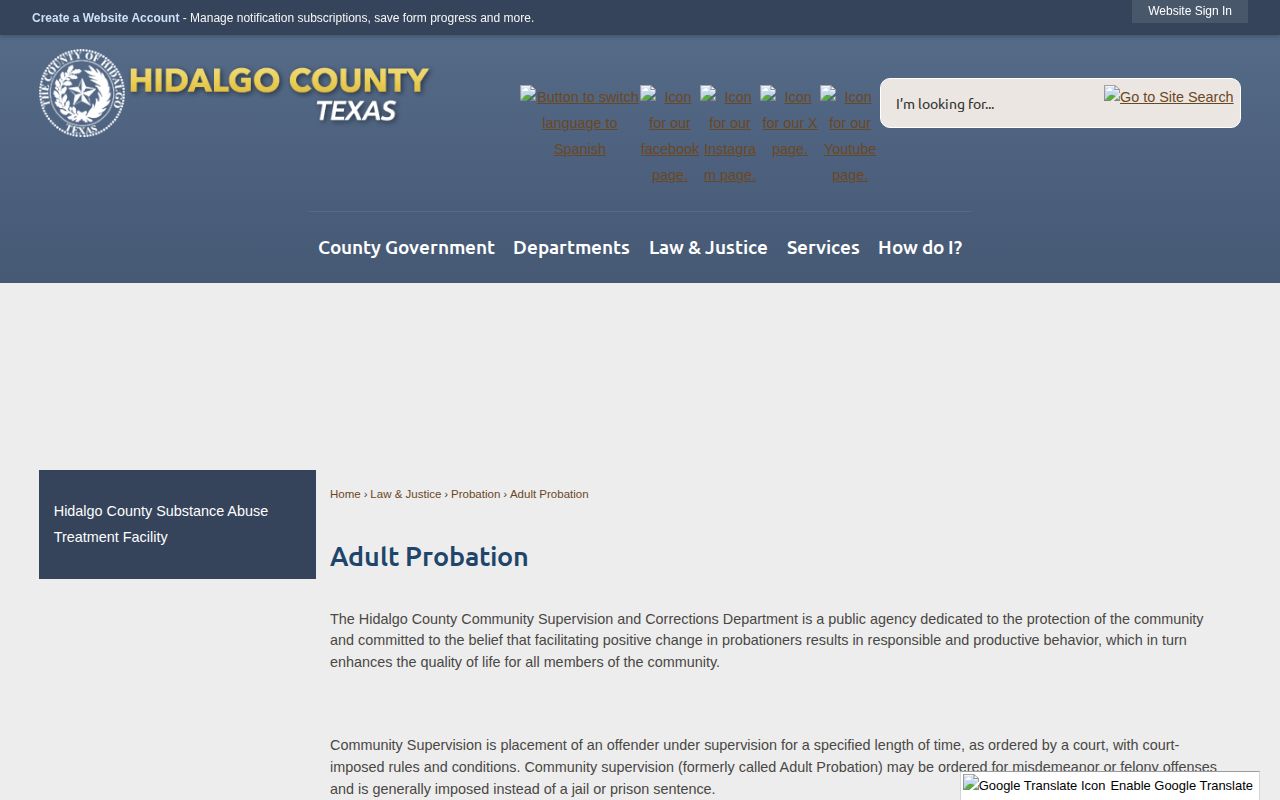
The image marks the county route. State supervision still belongs to TDCJ.
Texas Parole Review Has No Hearing
Ordinary Texas parole consideration is a file review, not a formal public hearing for the individual case. The BPP panel-review FAQ says panel members vote separately. Parole Division identifies initial-review cases about six months before eligibility and later reviews about four months ahead. An institutional parole officer prepares a summary, and a three-member panel votes in sequence. Two matching votes decide the case.
There is no Hidalgo parole-hearing calendar or routine courtroom date to consult. Public BPP meetings concern policy and public business, not individual case voting. The official statement is preserved in the image below.
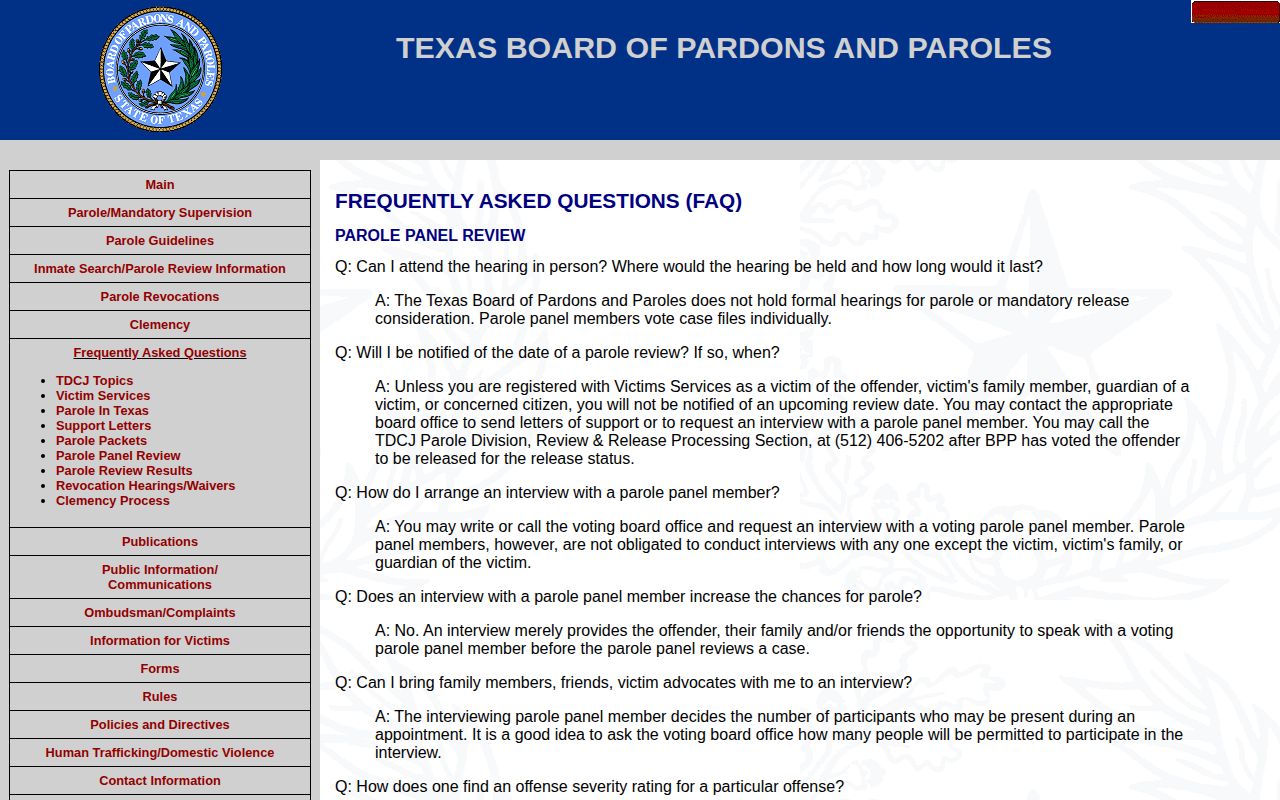
A review date is therefore not an appearance date and cannot establish release.
Hidalgo Parole Decision Codes
The live BPP voting-options legend explains results. FI-1 directs release when eligible. FI-2 specifies a later month and year. Several FI codes condition release on completion of a named TDCJ program and further timing rules. RMS means release to mandatory supervision. These are conditional decisions, not gate timestamps.
NR is a denial with a later review point. SA means serve-all within the code's rules. DMS denies discretionary mandatory supervision and sets a later review point. Consecutive-sentence codes require extra care. BPP may also withdraw an approval if new information arrives. The official code screen below is the right source because wording can change.
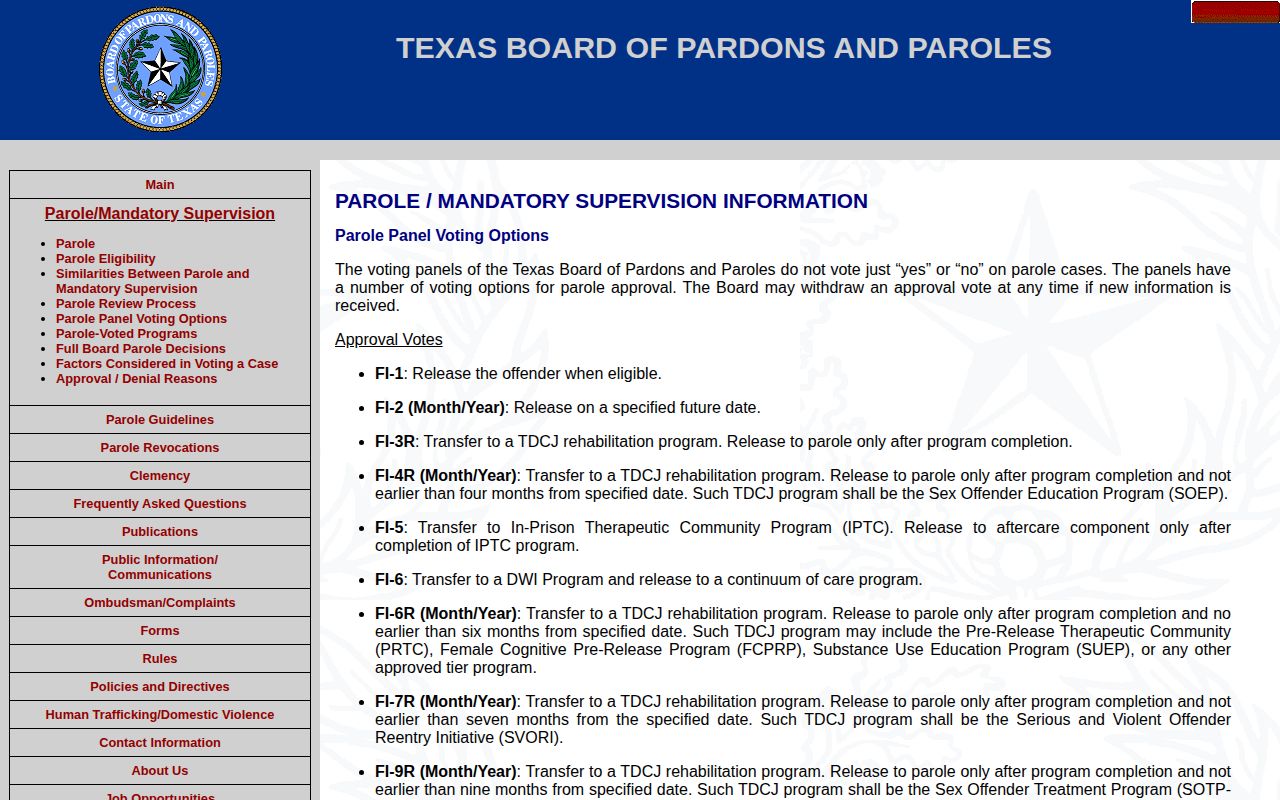
Pair the code with TDCJ release processing and an actual release record before saying the person left custody.
Hidalgo Absconder and Warrant Limits
TDCJ's absconder information defines an absconder as a supervised offender who stopped reporting and whose location is unknown. Its Warrants Section Command Center accepts anonymous tips at 866-680-6667 around the clock. That number is a reporting channel, not a public roster of all people under supervision.
The linked public search covers a narrower class of absconding registrants. Failure to find a name there does not prove compliance or the absence of a warrant. General parole warrants appear in law-enforcement systems that are not public databases. An arrest on a warrant also does not itself prove revocation. Notice and revocation procedures can follow.
When Hidalgo Supervision Ends
Supervision ends through the legal process tied to that case. A TDCJ discharge record can establish the end of the state sentence, while a court order establishes completion or termination of county probation. The Hidalgo County release record paths help separate departure from later discharge. For federal supervised release, consult the federal judgment and the proper U.S. Probation office.
Keep each event distinct: board vote, release processing, physical departure, start of supervision, and final discharge. A person may also enter new custody while an older supervision record remains active. The newest official record should be read alongside the original cause and sentence.
Hidalgo Notification Status Boundaries
TDCJ IVSS can provide state-custody, parole, and mandatory-supervision notifications for eligible registrations. Texas county notification moved to IVSS-Counties in 2025, so a county registration and a TDCJ registration are not interchangeable. If someone transferred from the Hidalgo jail into state custody, verify the state registration on the matching TDCJ record. An alert is useful corroboration, but it may follow the official event.
The public TDCJ IVSS landing page is shown below because it identifies the state status and registration channel. It does not reveal all terms of supervision and cannot replace the release or discharge record.
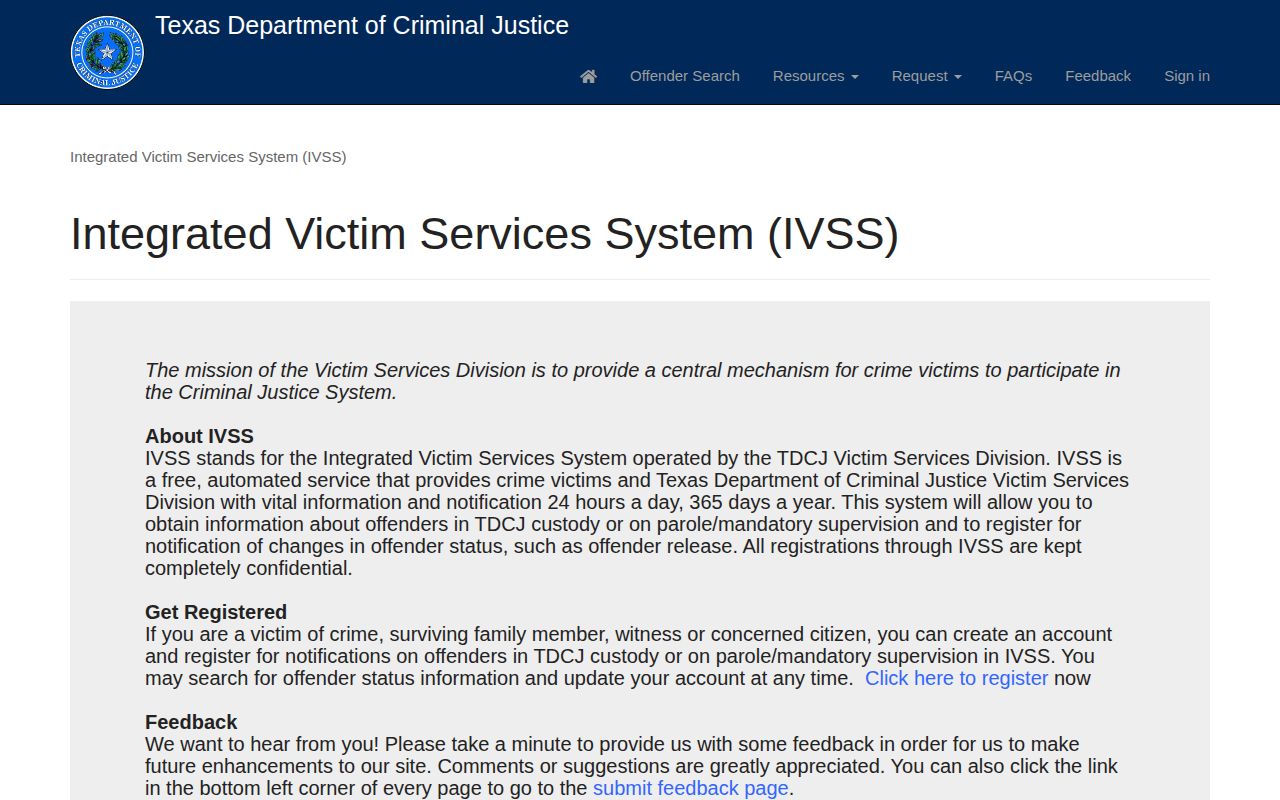
Use the originating TDCJ or Hidalgo County record when an alert and a custody result seem inconsistent.